
Thermoformed Pickleball Paddles: Construction, Cores and What to Check
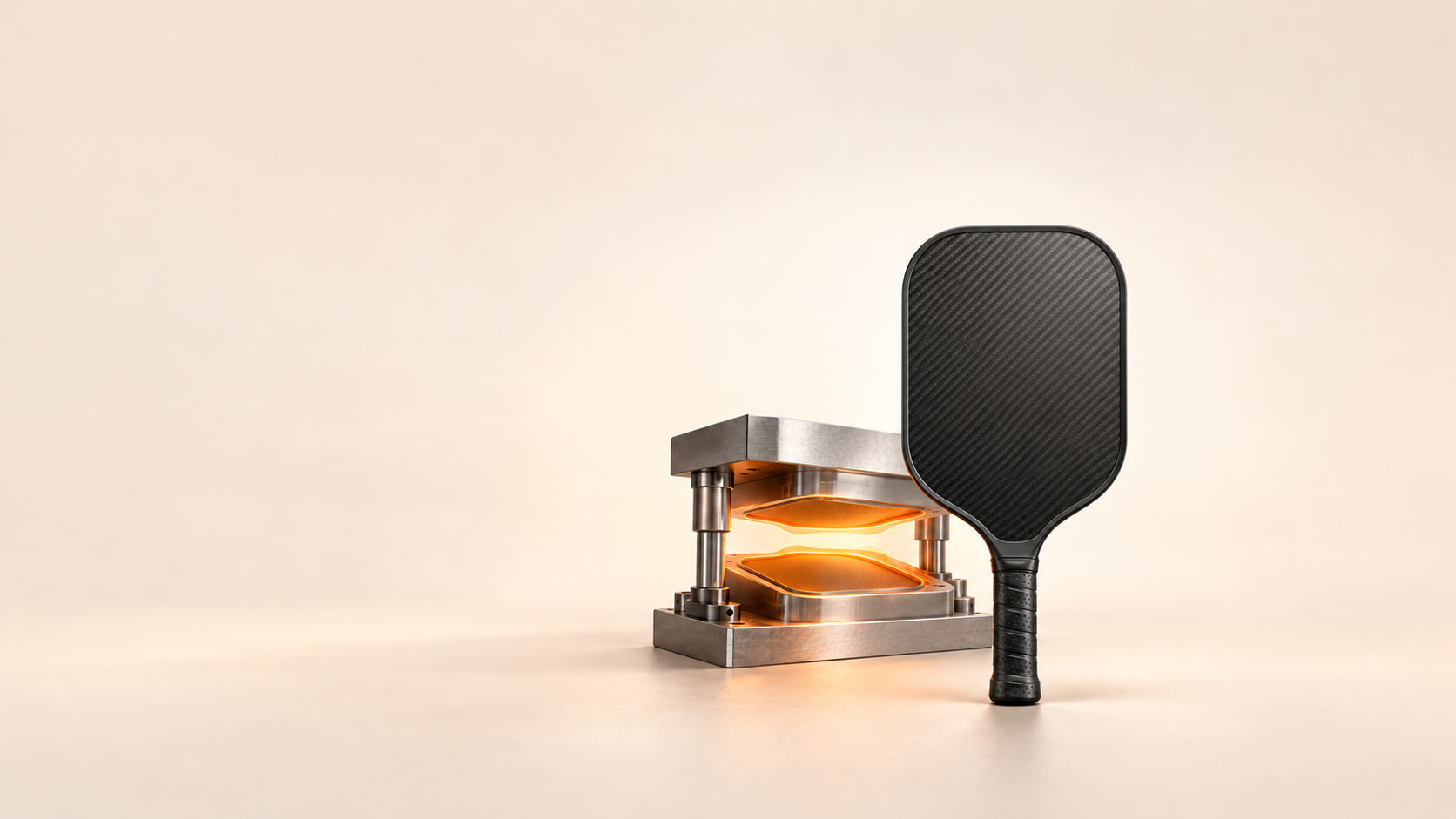
A thermoformed pickleball paddle is made using heat and pressure during forming or assembly. In a product description, “thermoformed” tells you about the manufacturing process. Terms such as honeycomb or foam describe the core material inside the paddle.
Those descriptions often appear together, which can make them sound interchangeable. Understanding the difference helps you compare thermoformed paddles and choose around the complete model.
Quick takeaway: Thermoformed describes a process. Unibody describes an integrated structure. Honeycomb and foam describe core materials.
What is a thermoformed pickleball paddle?
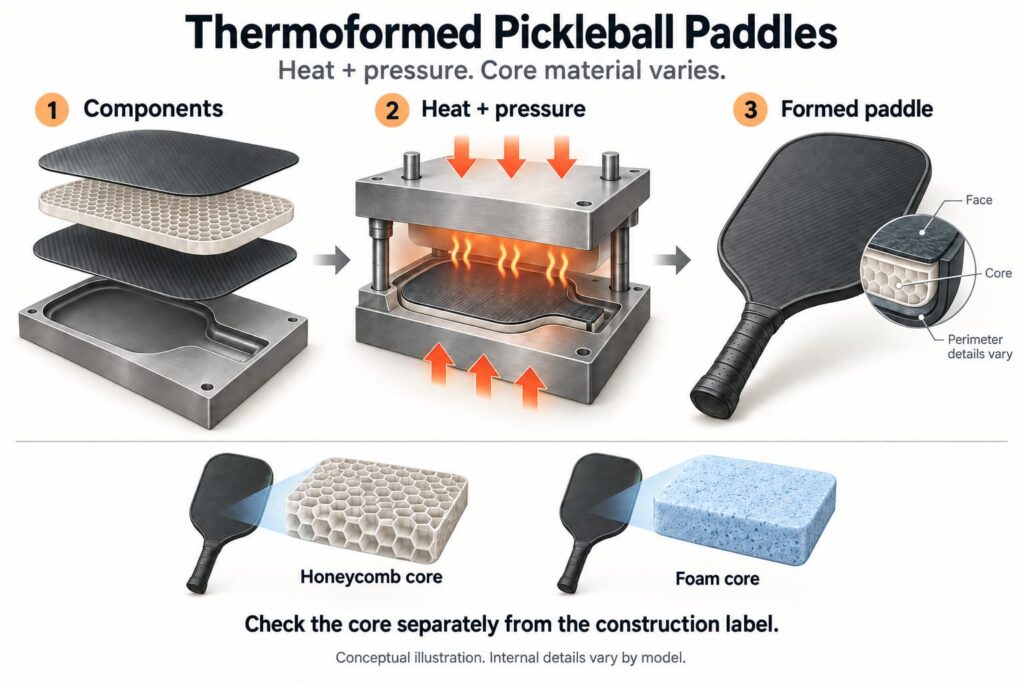
The basic idea is to hold paddle components in shaped tooling while applying heat and pressure. A mold is the tool that gives a part its intended shape or holds components in position during manufacturing.
In composite manufacturing, heat can be used during the curing of resin. Resin is the material that binds reinforcing fibers together; curing is the process through which it hardens. Pressure helps consolidate the material in the tooling.
Composites UK’s explanation of hot-press processing describes resin-impregnated fiber layers cured in matched tooling under pressure with heat transfer. Resin-impregnated means the fiber material already contains resin before processing.
For a paddle shopper, thermoformed is a useful construction description. To understand a particular model, read it alongside the core material and the manufacturer’s description of the structure.
Does heat turn the whole paddle into one material?
Heat and pressure do not mean that the different materials disappear. A finished paddle can still combine a carbon-fiber face, a honeycomb or foam core, and other structural components.
Construction terms also describe different aspects of manufacturing. A sandwich structure, for example, refers to outer layers arranged around a core. Thermoformed describes a process used during forming or assembly. A layered arrangement and a heat-and-pressure process can be part of the same design.
Is thermoformed the same as unibody?
Thermoformed and unibody answer different questions. Thermoformed concerns the process. Unibody describes a body arranged as an integrated structure, including how the paddle head connects to the handle.
A paddle can list both terms. You might see “thermoformed unibody” alongside a separate honeycomb-core or foam-core description.
| Term | What it describes |
|---|---|
| Thermoformed | Heat and pressure used during forming or assembly |
| Unibody | An integrated body construction |
| Honeycomb core | A core with a repeating hollow-cell structure |
| Foam core | A core made from cellular foam material |
An integrated structure can contain different materials. Hexcel’s sandwich design guide explains how bonded outer layers and a core work together as one unit. This helps explain why a construction described as one body can still have separate material layers.
When a product says unibody, read how the manufacturer describes that arrangement. The word alone does not identify every layer or connection used in the paddle.
Does thermoformed mean a foam core?
No. A thermoformed paddle can have a honeycomb core or a foam core. The process description and the core description are separate pieces of information.
A honeycomb core contains repeating hollow cells, like a honeycomb pattern. A foam core contains many cells within the foam material. Each description tells you about the core’s structure, while the complete paddle design determines how the model responds. If you are considering a switch, our comparison of foam core vs honeycomb pickleball paddles explains what to check.
Two thermoformed BECAVO paddles with different cores
The A01 and P01 provide a straightforward example. Both use thermoformed unibody construction, while their core materials differ.
| BECAVO model | Construction | Core |
|---|---|---|
| A01 16mm pickleball paddle | Thermoformed unibody | PP honeycomb |
| P01 16mm pickleball paddle | Thermoformed unibody | MPP foam |
The A01 combines this construction with a polypropylene, or PP, honeycomb core. The P01 combines it with an MPP foam core. Seeing the same construction wording on both models does not mean they have the same material inside.
Foam around the edge and a foam core are different
Some descriptions mention foam around the perimeter, meaning the outside boundary of the paddle head. That tells you where the foam is located. A foam-core description concerns the core itself.
If a page simply says “foam,” look for the accompanying explanation. Knowing whether it refers to the core or a perimeter treatment makes the comparison clearer.
How do thermoformed paddles compare with other constructions?
When you compare thermoformed vs. non-thermoformed pickleball paddles, consider the complete models. “Non-thermoformed” can cover different materials and assembly approaches, so it does not describe one uniform kind of paddle.
The construction label is useful when learning about a design, but it does not decide every aspect of play. Two thermoformed models can have different cores, shapes, weights and responses. Likewise, a model made through another construction process may still suit your preferences.
Will thermoforming give you more power or control?
Power concerns the pace you can produce on a shot. Control concerns how consistently you can place the ball where you intend. A manufacturing label alone cannot tell you how either will feel with a particular paddle.
Look for comparisons that identify the exact model and explain the conditions used. When you can try a paddle, judge the shots you can repeat comfortably. A faster ball is useful when you can still keep your placement.
Begin with a few firmer shots toward a target, then try gentle shots to a nearer target. Pay attention to how much adjustment each needs. That gives you a practical way to compare response without relying on the construction name.
What about durability?
To assess durability, look for information about the actual model and read the current support terms. Thermoformed alone does not tell you how long a paddle will last.
You may also encounter several damage terms:
- Delamination: separation between layers in a composite laminate, a structure built from layers.
- Disbonding: separation at a bonded connection between components.
- Core crushing: damage or collapse within the core itself.
The U.S. Government Accountability Office’s explanation of composite damage terms distinguishes delamination from disbonding. Separating layers and damaging the core describe different problems.
If you notice a new sound or a change in response, tell the seller which model you have, when the change appeared and what happens during use. Describing the change gives them more to work with than guessing the cause from the thermoformed label.
How to choose a thermoformed pickleball paddle
Once you understand the construction terms, compare the details that matter to your purchase. Use these five checks with the product pages open side by side.
- Core material: Check whether the model uses honeycomb or foam, and read the exact material description. If foam is mentioned, confirm whether it is in the core or around the perimeter.
- Construction details: Read the explanation of thermoformed and unibody, rather than treating the terms as a complete specification. Compare any additional structural information the manufacturer provides.
- Weight and grip: Compare the weight range and grip measurements. If you own a paddle, use it as a reference; if this is your first one, holding or borrowing a paddle can help. Our paddle guide brings the BECAVO model specifications together.
- Playing response: Try both firmer and gentle shots when a demo is available. Notice whether you can repeat your placement and make comfortable contact.
- Support: Read the current return and warranty terms before buying, especially if you have not had a chance to try the model.
If you already know the common pickleball shots, include drives, which are firmer attacking shots; volleys, which are hit before the ball bounces; and dinks, which are gentle shots into the area near the net.
For a first paddle, focus on a comfortable grip, a weight you can manage and a response you can learn to repeat. The construction category can help you understand your options while those practical checks help you make the choice.
Frequently asked questions
Does thermoformed mean a foam core?
No. Thermoformed describes a manufacturing process involving heat and pressure. Foam core describes an interior material. BECAVO’s A01 uses thermoformed unibody construction with a PP honeycomb core, while the P01 uses the same construction wording with an MPP foam core. Read both fields when comparing models.
Is unibody the same as thermoformed?
The terms describe different aspects of construction. Thermoformed concerns heat and pressure used during forming or assembly. Unibody describes an integrated body arrangement. A paddle can list both while containing separate face and core materials. Read the manufacturer’s description to understand how those materials and components are arranged.
Are thermoformed paddles always more powerful?
The construction label alone does not establish a power advantage. The complete design and your swing matter. Compare information about the actual model, then try firmer and gentle shots when possible. Pay attention to placement as well as pace so you can judge whether the response suits your game.
Should a beginner choose a thermoformed paddle?
A beginner can include thermoformed models in a comparison. Start with a manageable weight and a grip you can hold comfortably, then consider the full specifications and support terms. If you can try different models, compare how easily you repeat basic shots. Choose around the complete paddle’s fit and response.
Compare the complete paddle
Thermoformed pickleball paddles use heat and pressure during forming or assembly, while their cores and other design details can differ. Read the construction and core descriptions together, then compare fit and playing response.
Our 16mm pickleball paddle comparison puts the A01 and P01 specifications side by side. Use it to compare two thermoformed models with different cores and find the details that matter to your choice.
Share options