
Foam Core vs Honeycomb Pickleball Paddles: Should You Switch?
Your honeycomb paddle still feels familiar, but foam-core paddles keep appearing on your shortlist. Would changing cores actually help your game?
When comparing foam core vs honeycomb pickleball paddles, start with the shot you want to improve. A different core is worth exploring when a specific paddle helps you make that shot without giving up something you value. If your current paddle is comfortable and dependable, keeping it is a reasonable choice.
Foam core vs honeycomb: what changes inside the paddle?
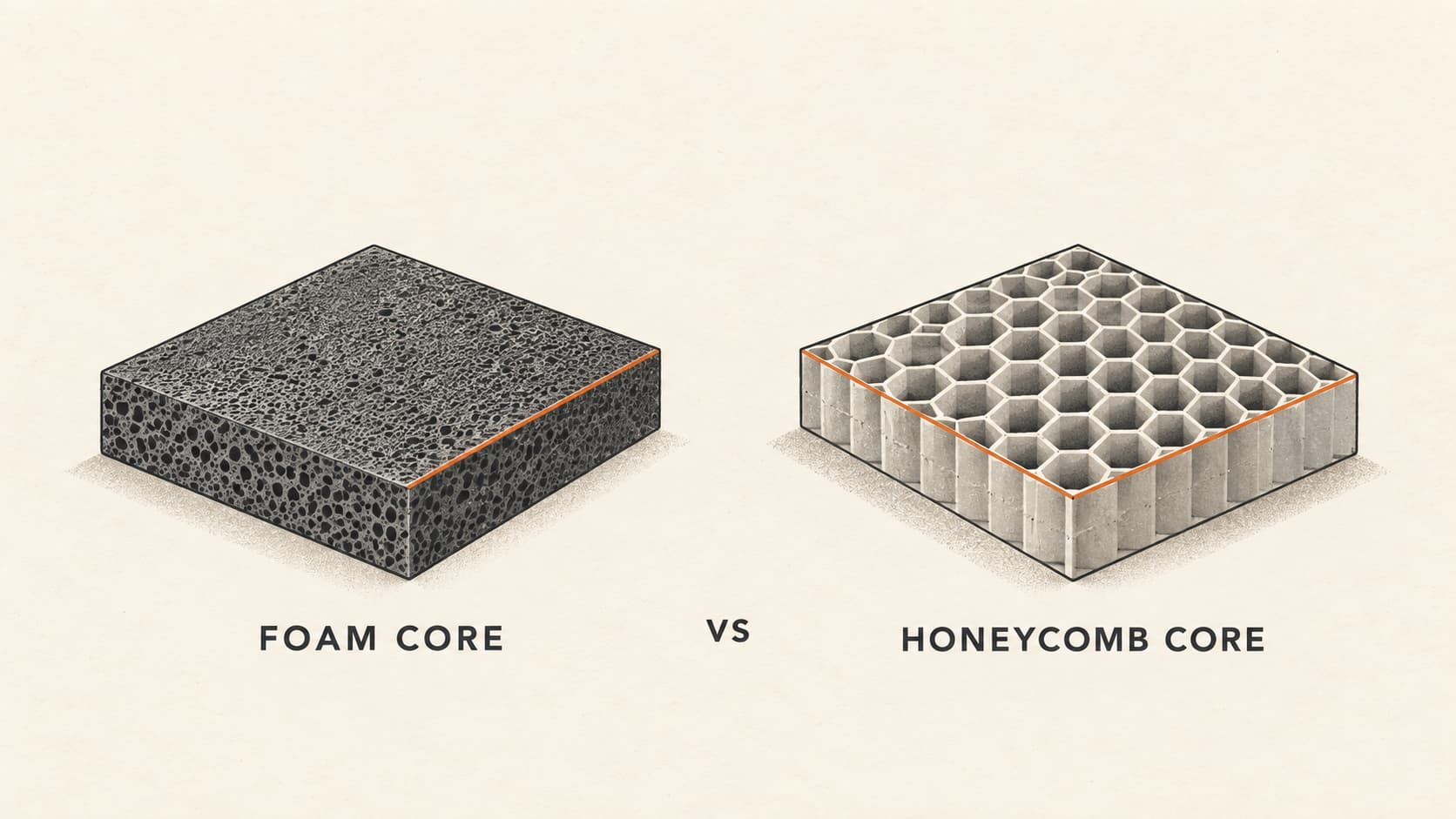
The core is the material between the paddle’s two hitting faces. A honeycomb core has repeating hollow cells. Polypropylene, often shortened to PP, is one material used to make that structure.
In a foam-core paddle, foam forms the core beneath the hitting faces, sometimes alongside other supports. Different foam designs can give two paddles quite different constructions. Perimeter foam means foam placed around the edge area; a paddle can have that feature while retaining a honeycomb core.
Look for a description of what sits beneath the hitting area. A mention of “foam injection” alone leaves that question open. Likewise, thermoformed describes a manufacturing process using heat and pressure; our guide to thermoformed paddles explains how it relates to core and construction terms.
The faces and their connection to the core matter as well. Hexcel’s sandwich-construction guide explains how bonded outer layers and a core work together as a unit. That is a useful reason to read the complete construction description when comparing paddles.
Compare feel, power and control separately
A paddle can feel pleasant in your hand while still needing an adjustment to your shots. Words such as “crisp,” “muted” or “soft” help describe contact, but they leave another question unanswered: where does the ball go?
During a demo, separate the sensation of contact from the result. On a short block, notice how easily you keep the ball low. On a drive, notice whether you reach your intended depth with a comfortable swing. A paddle that helps one shot may ask for a different movement on another.
Laboratory research also shows why broad labels leave room for differences. Pickle Pro Labs’ Paddle Performance Trends report describes a wide range of rebound measurements among both honeycomb and foam designs in its sample. Its findings support comparing specific models rather than assigning every foam or honeycomb paddle the same playing character.
If your main question is about playing style, our control vs power paddle guide can help you narrow the direction. Then bring that priority back to the actual paddle you are considering.
When is a switch worth trying?
You have a specific shot you want to improve
“My blocks keep floating high” gives you a useful starting point. So does “I want easier depth on drives.” Either problem can justify trying another paddle, including a foam option, while keeping honeycomb models in the comparison.
Choose one shot to work on and one you already trust. For example, compare your drive, then return to a familiar dink. An improvement is more useful when you can keep the dependable part of your game too.
You want a different feel at contact
If you dislike your current paddle’s feedback, try a few specific models before deciding that an entire core category suits you. Give yourself time to adjust, then check your placement again. Enjoying the sensation matters, and seeing where your shots land helps you judge the change.
Your current paddle already does what you need
You can stay with it. Familiar handling, comfortable fit and a response you trust are good reasons to keep playing with a paddle. A new core description can give you something to explore later, without creating a reason to replace a paddle you still enjoy.
Use a simple comparison sheet
If you can borrow a paddle or arrange a demo, bring your current one. Use the same ball and a similar feed where practical. Record the exact models, any added weights or overgrips, and visible face wear. Those details help you remember what you actually compared.
Copy the table below into your phone or notebook. Fill it in after trying each paddle, then revisit it after a few points. It is a personal decision aid, not a laboratory test.
| What to record | Current paddle | Paddle you are trying |
|---|---|---|
| Model and setup | Model, added weight, grip, face condition | Model, added weight, grip, face condition |
| Fit and handling | Handle space and ease of getting ready | What feels different? |
| Shot you want to improve | What usually happens? | What changed, and was it repeatable? |
| Shot you already trust | Your familiar result | Still dependable, or harder to place? |
| Contact feel | Your own description | Your own description |
| Adjustment needed | What you already work around | What you would need to practice |
| Decision | Keep, compare again, or replace | Why this model earns another try |
A note such as “drives reached my target more easily, but blocks kept going long” is more useful than a single “better” score. That example is hypothetical. Your own notes should describe what happened and which trade-off you would be willing to practice around.
Changing paddles usually changes several things together. If the new one has a different shape, grip or weight setup, your notes cannot tell you that the core alone caused the difference.
Does a foam core mean the paddle will last longer?
The core name does not give you a replacement date. To compare durability, look for evidence about the exact model over time, read its care instructions and warranty, and check how the seller handles a possible fault.
Pickle Pro Labs’ Paddle Break-In Trends study measured changes in rebound after repeated pressing and bending in the lab. Foam designs in that sample showed different patterns of change. Those results do not translate into a number of months of normal play for a paddle on your shortlist.
If your paddle suddenly responds differently or has visible damage, ask the manufacturer or seller about that specific change. Calling it “break-in” does not establish what happened inside it. Describe what changed so the seller can help you decide what to do next.
A honeycomb and foam example from BECAVO
In our current lineup, the BECAVO A01 uses a PP honeycomb core and belongs to the A Series all-court collection. The BECAVO P01 uses an MPP foam core and belongs to the P Series power collection.
Both have a T700 raw carbon fiber face, 16 mm thickness, thermoformed unibody construction and a listed weight range of 220–240 g. Their dimensions and grip fit still give you more to compare:
| Specification | BECAVO A01 | BECAVO P01 |
|---|---|---|
| Core | PP honeycomb | MPP foam |
| Overall size | 415 × 190 mm | 420 × 190 mm |
| Grip circumference | 110 mm (about 4.33 in) | 105 mm (about 4.13 in) |
| Handle length | 140 mm (about 5.51 in) | 140 mm (about 5.51 in) |
A01 is the all-court starting point for a varied game; P01 is the power-focused starting point for drives and finishing shots. These are the models’ intended roles. Their specifications alone do not measure how much more power or control either will give you.
Common questions about foam and honeycomb paddles
Is foam around the edge the same as a foam core?
Foam around the perimeter can sit alongside a honeycomb core. It tells you where some foam is placed, while the material beneath the hitting area still needs its own description. Check the exact model’s construction details before treating “foam injected” and “full foam” as the same thing.
Should beginners choose foam or honeycomb?
Start with a comfortable grip, manageable handling and a response you can learn to repeat. Include both core types if you have suitable models to try. Compare ordinary returns, soft shots and blocks before putting too much weight on one powerful hit. The specific paddle and your budget matter more than a rule about which core beginners must use.
Decide what you want to change
A foam core vs honeycomb comparison is most useful when it ends with a clear decision about your game. Keep a paddle that already works, or try a specific replacement against a problem you can describe. If a switch helps that problem and the adjustment feels worthwhile, you have a reason to consider it.
Write down the shot you want to improve before your next demo. Let that answer guide your shortlist.