
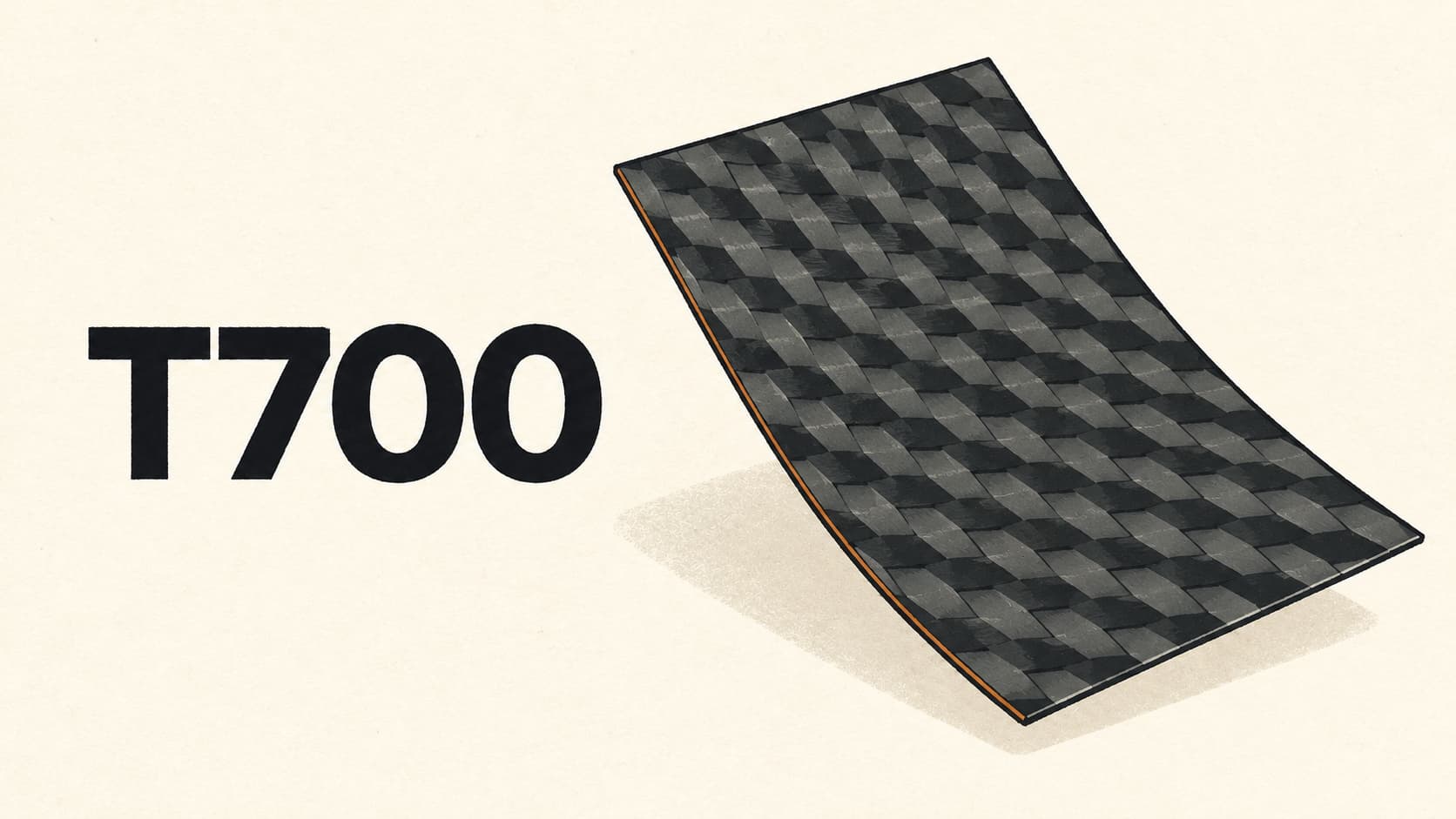
T700 Carbon Fiber Pickleball Paddles: What the Label Means
You open two paddle pages. Both say “T700 carbon fiber,” but the cores, prices and descriptions are different. How much does that shared label actually tell you?
A T700 carbon fiber pickleball paddle uses the stated T700 fiber grade in its face material. That tells you something about the carbon fiber, while the surface finish, core and complete construction still need their own descriptions. Use T700 as a starting point for comparing specifications.
What does T700 mean on a pickleball paddle?
T700 is a carbon fiber grade designation. For a concrete reference, Toray’s carbon fiber catalogue lists T700S as a high-strength, standard-modulus fiber. Strength describes resistance to breaking under load; modulus describes stiffness. They are different properties.
The full name matters, too. Toray lists T700S and T700G separately, with differences in their material specifications. A paddle page that says only “T700” does not identify that full grade or establish who supplied the fiber. If a particular supplier matters to your purchase, look for a clear statement for that model.
For the player, the useful question is what comes after the material name. Which core sits beneath the face? How is the surface finished? What does the manufacturer disclose about the completed paddle? Those details help you compare two models that share the same headline material.
T700, 3K, raw and 16mm describe different things
These terms can appear together because they answer different questions. Read each one in its own column of a specification sheet.
| Label | What it describes | What to check next |
|---|---|---|
| T700 | The stated carbon fiber grade | The exact material description and any model-specific supplier information |
| 3K or 12K | Filament count in a fiber bundle, called a tow | The fabric or layup description; K count alone does not describe the finished surface |
| Raw carbon fiber | A surface description used in paddle marketing | The model’s actual finish and texture explanation |
| 16mm | A listed thickness measurement | Which thickness the specification measures, plus the core material and structure |
| Thermoformed | A manufacturing-process description | The complete construction details for that paddle |
T700 vs 3K: grade and bundle size
K means thousand: 3K refers to 3,000 filaments in a tow, and 12K refers to 12,000. A tow is a bundle of individual carbon filaments, as explained in Toray’s materials terminology.
So “T700 vs 3K” is not a choice between two equivalent material grades. One names a grade; the other gives a bundle size. Neither tells you the number of carbon layers in the paddle. You also cannot reliably identify the grade or full construction from a visible woven pattern.
T700 vs raw carbon fiber: material and surface
T700 identifies the fiber grade; raw carbon fiber describes the face surface. A paddle can use both terms. BECAVO’s A01 and P01 use T700 raw carbon fiber faces, so their specifications include both the grade and the surface description.
Do not read “raw” as proof that the face contains no resin. Carbon fiber composites combine reinforcing fibers with a resin matrix, the material surrounding and binding them. Hexcel’s composites glossary explains this distinction through its definitions of reinforcement, resin matrix and prepreg. A surface label does not replace a description of that composite construction.
What a fiber data sheet tells you about a paddle
A material data sheet is useful when you want to understand the fiber itself. It becomes less useful when someone treats a fiber specification as a finished-paddle performance score.
The Toray T700S data sheet separates fiber properties from composite properties and states conditions for the composite specimens. The resin system, fiber content and preparation belong to those results. They cannot simply be transferred to a paddle with a T700 label.
Think of the information in three steps:
- Fiber grade: What reinforcement material is specified?
- Composite face: How are the fibers, resin and layers combined?
- Finished paddle: How does that face work with the core, shape and complete build?
By the third step, you need evidence about the actual model. A fiber tensile-strength figure does not give you a spin rate, a ball-speed measurement or a promise about how long the paddle will last.
If a review provides test numbers, check the model and version tested, the method and the comparison conditions. If you get a chance to demo the paddle, use the shots you want to improve: a soft drop, a reset under pressure, a drive and a quick exchange. Keep those observations separate from what the material label says.
Two T700 faces, two different sets of specifications
The current BECAVO lineup shows why it pays to keep reading after “T700.” Both the A01 and P01 use a T700 raw carbon fiber face, a 16 mm core and thermoformed unibody construction. Their core descriptions and series roles differ.
| Listed specification | BECAVO A01 | BECAVO P01 |
|---|---|---|
| Face material | T700 raw carbon fiber | T700 raw carbon fiber |
| Core thickness | 16 mm | 16 mm |
| Core description | PP honeycomb | MPP foam |
| Construction | Thermoformed unibody | Thermoformed unibody |
| Series role | A Series / All-Court | P Series / Power |
The A01 is positioned for a game that mixes soft placement, quick exchanges and attacking shots. The P01 is positioned around drives and finishing shots. Those are BECAVO’s intended roles for the models; the shared T700 label does not explain the whole difference or quantify either paddle’s performance.
Use the BECAVO 16mm paddle comparison to compare the current models side by side. For more detail on the manufacturing term, see our guide to thermoformed pickleball paddles.
A practical checklist before choosing a T700 paddle
Once you understand the label, turn it into a few useful buying questions:
- Read the complete face description. Separate the fiber grade from any weave, K-count or surface claim. Ask about a missing detail if it affects your choice.
- Check the core and construction. Record the core material, structure and thickness. Two matching thickness numbers do not make two paddles equivalent.
- Check physical fit. Compare listed weight, dimensions and handle specifications with a paddle you already find comfortable. If handling measurements are available, keep their test methods in mind.
- Match the evidence to your priority. For spin, look for model-specific surface information and relevant testing. For durability, examine the construction details, care instructions, warranty and evidence from use over time.
- Make a plan to try it. Check demo availability and the seller’s return conditions. During a demo, repeat a small set of familiar shots so you have a useful basis for comparison.
If your shortlist still looks identical, write down one question about each model that the product page has not answered. A clear answer about the core, surface or fit can help you choose more than another mention of T700.
T700 paddle FAQs
Is T700 better than T800 carbon fiber for pickleball?
The numbers alone do not settle the choice. Toray’s catalogue places T700S in its standard-modulus range and T800S in its intermediate-modulus range. Those are fiber properties. Choosing a paddle still requires comparing the complete models, their construction and evidence about the performance you want.
Does T700 carbon fiber guarantee more spin?
No. The grade name does not report a finished paddle’s surface texture or measured spin. Look for details and testing for the exact model. Two paddles with T700 faces should not be assumed to produce the same spin.
Is every T700 paddle made with Toray carbon fiber?
A listing that says only “T700” does not establish Toray as the supplier. Look for an explicit model-specific sourcing statement if that distinction matters to you. Toray’s technical documents explain its own grades; they do not verify the supply chain of every paddle using the label.
How long does a T700 pickleball paddle last?
There is no service-life estimate contained in the T700 designation. To judge a particular paddle, consider evidence about its surface and construction over time, follow its care instructions and read the warranty terms. A fiber-grade comparison cannot establish a replacement interval.