
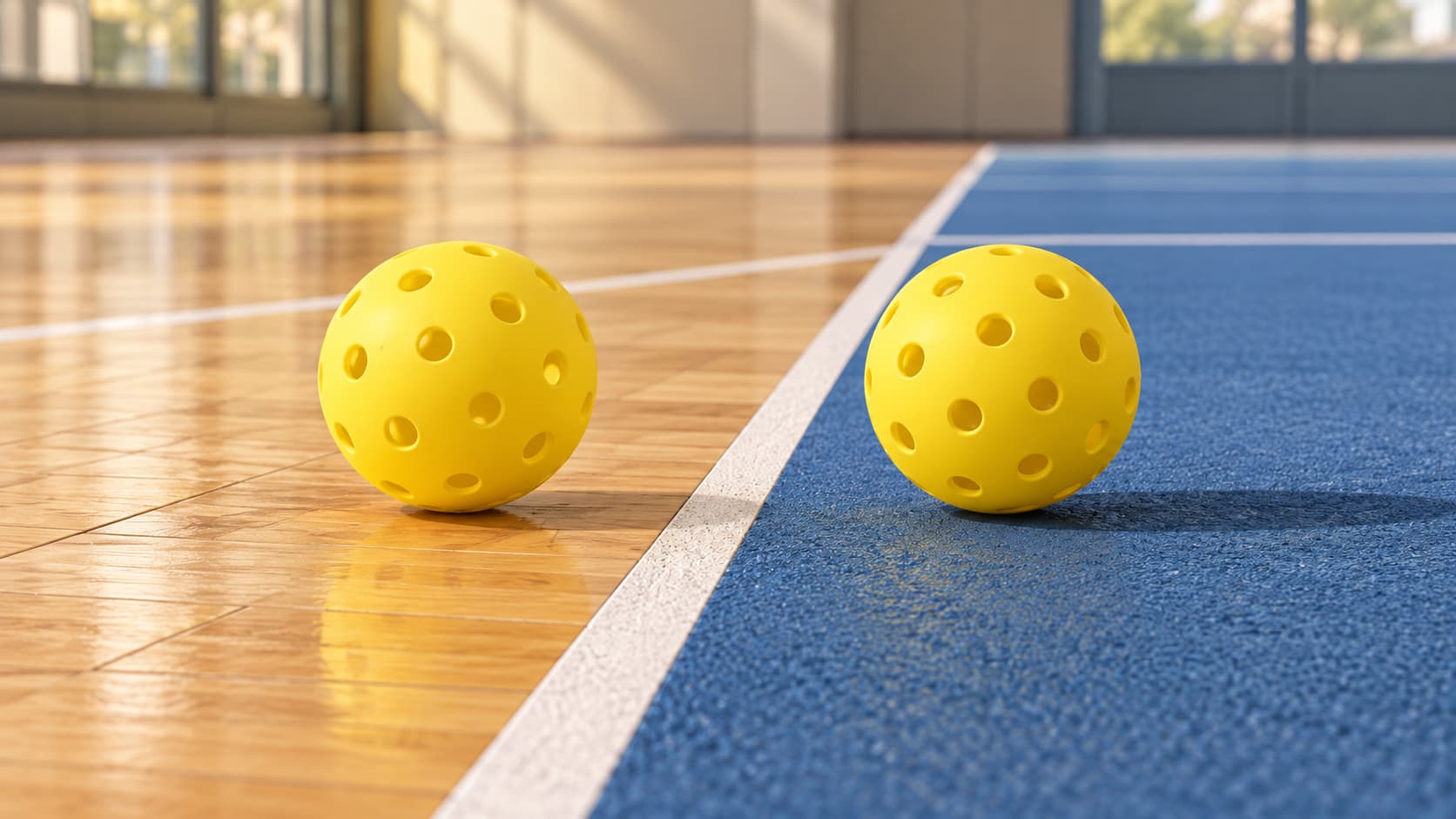
Indoor vs Outdoor Pickleballs: Choose the Right Ball for Your Court
If you’re comparing indoor vs outdoor pickleballs, start with the court surface and the ball your venue uses. A 26-hole indoor-style ball is a common choice for gym-floor sessions, while a 40-hole outdoor-style ball is commonly used on hard courts, including some courts inside buildings. Confirm the venue’s usual ball before buying a pack.
The labels are useful, but they can leave you with a practical question: what should you bring to an indoor facility with a textured court? Looking at the floor, checking the specific model and asking the people who run the session will give you a clearer answer than the word “indoor” on its own.
Indoor vs Outdoor Pickleballs: Start With Your Court Surface
Picture two places to play: a school gym with a basketball floor and a dedicated pickleball facility with coated hard courts. Both have walls and a roof. They may still use different ball types.
For a gym-floor session, an indoor-style ball is a sensible starting point to discuss with the organizer. The LTA’s pickleball equipment guide describes 26-hole indoor balls as suited to smoother indoor surfaces. At an indoor hard-court facility, ask which ball is normally used there before choosing an indoor-labeled pack.
If you cannot identify the surface, describe the venue when you ask. “We play in a school basketball gym” is more useful than “we play indoors.” For a dedicated facility, ask for the ball’s brand and model. That gives you something specific to look for on a product listing.
What Does the Hole Count Tell You?
A common distinction is 26 holes for an indoor-style ball and 40 holes for an outdoor-style ball. You will also see differences in the listed weight, materials and hole size across models. Those details need to come from the individual product description; the hole count alone does not tell you all of them.
| What you see on the listing | How to use that information |
|---|---|
| 26 holes / indoor | A common starting point for gym-floor play. Check the maker’s suggested use and the venue’s usual ball. |
| 40 holes / outdoor | A common starting point for hard-court play. This can include a hard court inside a building. |
| Weight, diameter and material | Read the actual model’s specifications. Two different hole-count options can share these listed details. |
| A model name specified by the venue | Match the full model name when buying for that session, rather than choosing another ball by hole count alone. |
The numbers 26 and 40 are common product conventions, rather than the only two hole counts described in the standards. Section 2.D.8 of USA Pickleball’s Equipment Standards Manual gives a range of 26 to 40 circular holes. For choosing a ball, use the hole pattern as one clue alongside the model’s specifications and intended use.
Keep the model name when you save a shopping link. “A yellow 40-hole ball” may describe several products with different specifications. A listing with clear materials, dimensions and suggested use gives you more information to work with.
Which Ball Should You Bring? Four Common Court Scenarios
Your regular venue is the best place to start. The following situations show what to check before adding balls to your bag.
| Where you play | What to check before you buy |
|---|---|
| School gym or recreation-center gym floor | Ask whether the session uses an indoor-style ball and which model the organizer recommends. |
| Indoor facility with a textured hard court | Ask for the usual hard-court ball model. An outdoor-style ball may be the expected choice despite the roof. |
| Outdoor pickleball court or converted tennis court | Start with the manufacturer’s outdoor-use recommendation, then match any ball preference set by the venue or playing group. |
| A mix of gym floors and dedicated hard courts | Check each venue separately. You may need different balls for the two sessions. |
A short message can settle the choice: “I’m coming to the Tuesday session. Which ball model do you use on that court, and do I need to bring my own?” This also tells you whether buying balls is necessary for the session.
For a club event or organized competition, check its instructions before ordering. The event may specify a particular model. Having the same number of holes as that model does not make another product the specified ball.
Can You Use Outdoor Balls Indoors, or Indoor Balls Outside?
Using an outdoor-style ball indoors
An outdoor-style ball can be the appropriate choice for an indoor hard-court session. Confirm the facility’s usual model rather than changing ball type just because the court is under a roof. In a gym, check with the organizer before bringing a ball bought for outdoor court use.
Using an indoor-style ball outside
Before taking an indoor-style ball to an outdoor session, check its manufacturer’s suggested use and the group’s usual ball. For a purchase intended mainly for outdoor courts, start with an outdoor-use option. A ball you already own may still need a separate check against the requirements of that particular session.
Taking one pack to different venues
One pack is a straightforward choice if both venues use the same model. If their recommendations differ, keep the packs identifiable so you can bring the right one to each session. Ask before buying a large quantity, especially when you are trying a venue for the first time.
Choosing Between BECAVO’s 26-Hole and 40-Hole Options
The BECAVO B Series pickleball pack has two hole-count options. Choose 26-Hole for the brand’s suggested indoor gym-floor use, or 40-Hole for its suggested outdoor court use. For an indoor hard court, confirm the ball type used by the facility or group.
| BECAVO option | Suggested use | Listed weight per ball |
|---|---|---|
| 26-Hole | Indoor gym-floor sessions | 26 g, approximately 0.92 oz |
| 40-Hole | Outdoor court sessions | 26 g, approximately 0.92 oz |
Both options are listed as injection-molded thermoplastic elastomer (TPE), with a diameter of 74 mm, approximately 2.91 inches, per ball. Both are yellow. The pack contains three balls of the hole-count option you select, and is priced at $8.
That shared 26 g specification is worth noticing when you compare the options. It shows why a general description of indoor balls as lighter should not replace the details on a particular listing. Here, the confirmed choices are the hole-count option and its suggested use; the listed weight and material are the same.
Select one hole count for the pack before ordering. The three-pack contains three balls of that selected option, so a 26-Hole order is not a mixed pack containing both types.
Three Checks Before You Buy
Before choosing a pack, make sure you can answer these questions:
- What does this session use? Confirm the court surface and the venue’s usual ball model.
- What does this product list? Check the hole count, material, size, weight and suggested use for the exact option.
- What will arrive in the pack? Confirm the quantity and selected variation, particularly if you need balls for more than one venue.
With those details in hand, you can choose a ball for the sessions you actually attend. If BECAVO’s suggested uses match your plans, choose your hole count and check the selected option before ordering.