
Pickleball Paddle Grip Size: How to Measure and Find Your Fit
Your current paddle can be a useful starting point when you are choosing a new grip size. Measure the handle as you use it, including any overgrip, then compare that measurement with the next paddle’s specifications. A familiar handle gives you something concrete to compare with a size chart.
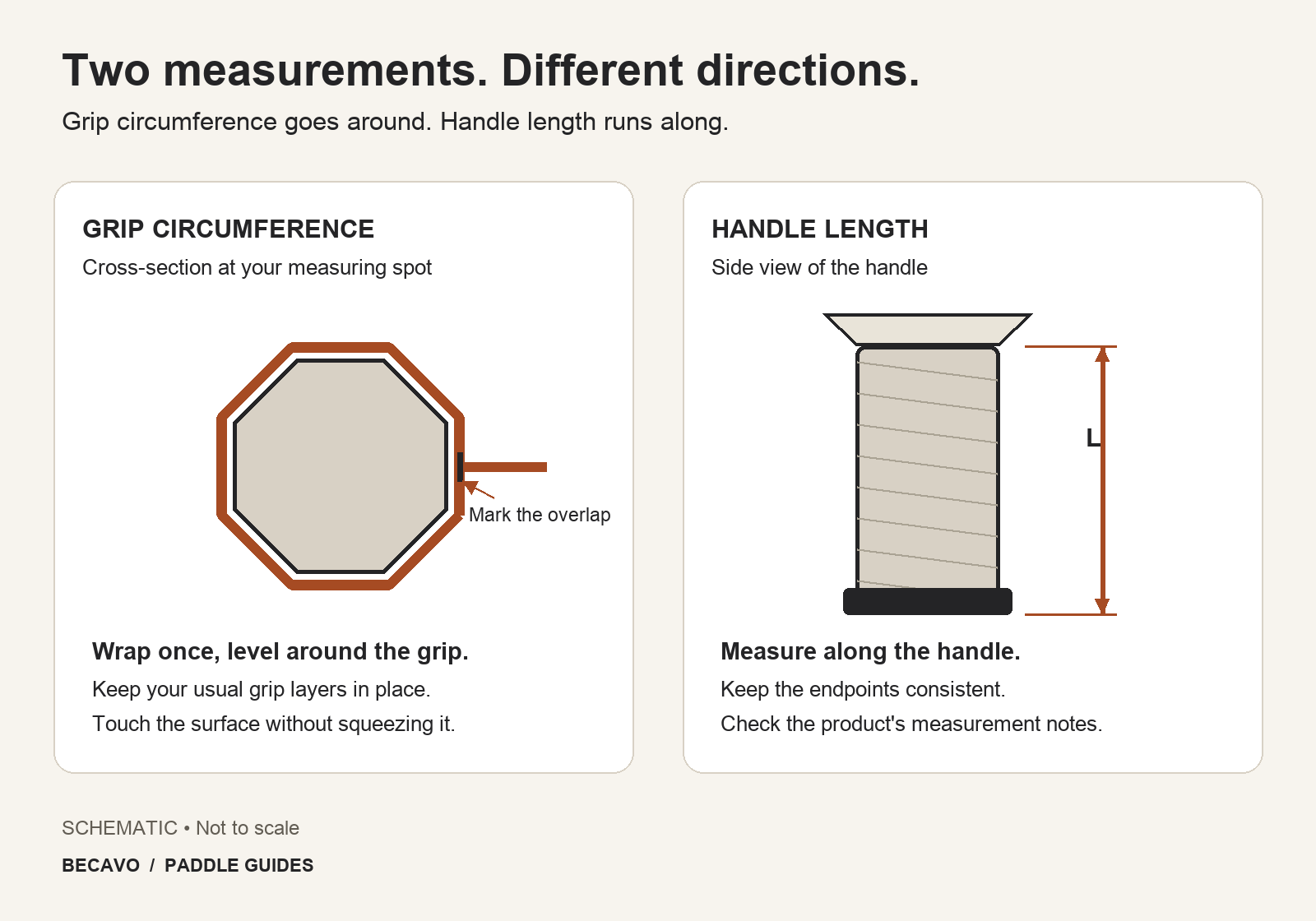
Pickleball paddle grip size means the circumference, or distance around, the handle. It is separate from handle length. Measuring it helps you compare sizes; holding and playing with the paddle helps you decide how the fit feels.
Grip circumference, handle length and hand size
A measurement such as 4 1/4 inches describes the distance around the grip. Handle length describes how much room you have along the handle, which matters when you place both hands on it. Neither measurement tells you the size of your hand.
Keep these measurements separate when reading a product page. A longer handle can have a small circumference, and a shorter handle can feel thick. For help comparing the rest of a paddle’s specifications, see our pickleball paddle buying guide.
How to Measure Your Pickleball Paddle Grip Size
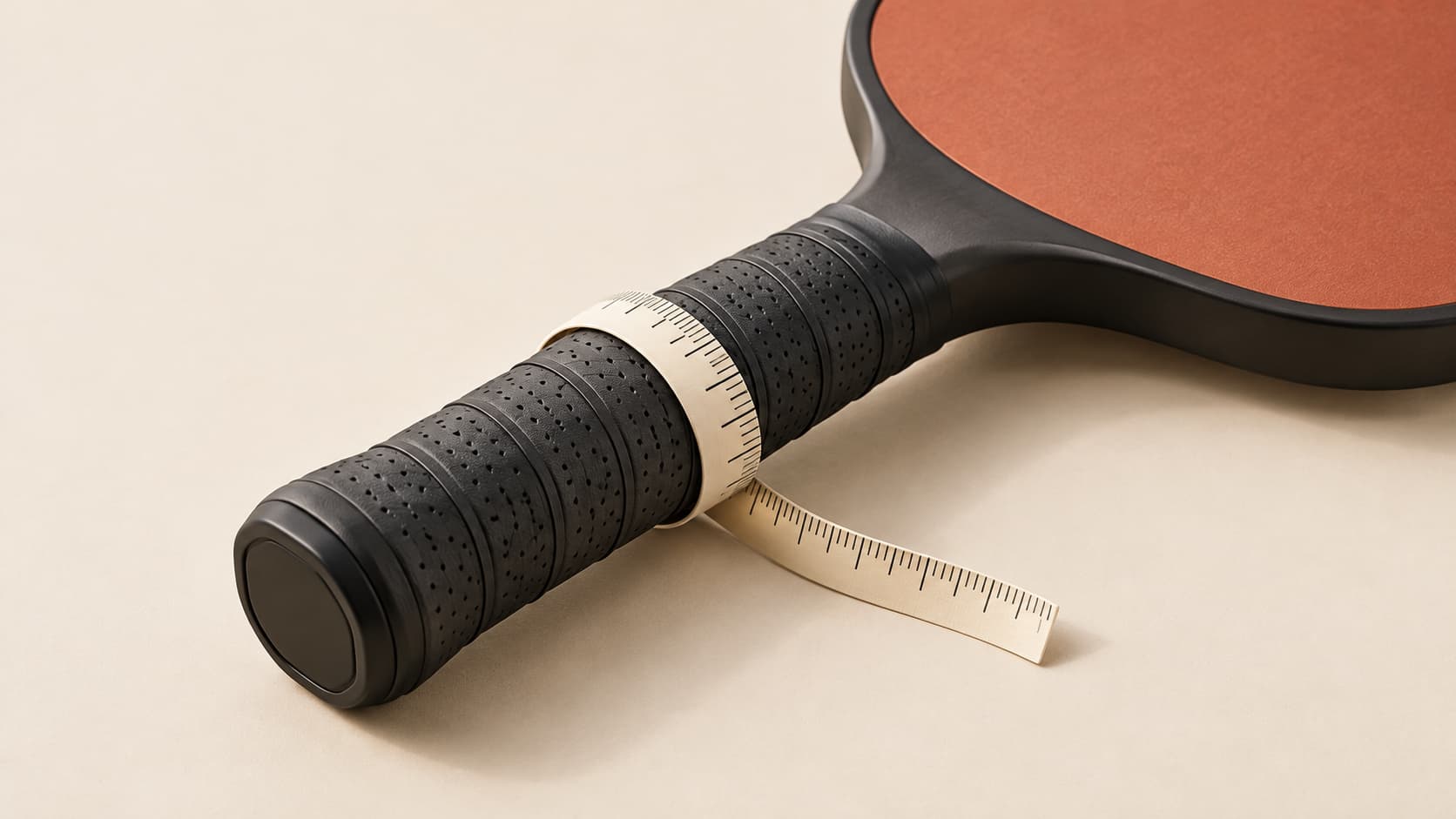
You need a flexible measuring tape, or a narrow strip of paper and a ruler. Use paper that bends around the handle without stretching. The goal is a repeatable comparison of your current setup.
- Keep your usual grip setup. Leave the base grip and any overgrip in place if you want to measure what you currently hold. Note how many overgrips you use.
- Choose a spot on the handle. Use the area where the middle of your gripping hand normally sits. Avoid the flared cap at the bottom and the finishing tape at the top. Note the location so you can measure there again.
- Wrap once around that spot. Keep the tape or paper level, across the handle rather than spiraling up it. Bring it into contact with the grip without pulling hard enough to compress the padding.
- Read or mark the overlap. With a tape, read where the scale meets its zero mark. With paper, mark where the starting edge meets the strip, then lay it flat and measure from that edge to the mark.
- Repeat at the same spot. If the readings differ, check the angle and tension before recording a result. Write down the unit, location and grip setup alongside the measurement.
If the handle changes thickness along its length, you may get different readings at different spots. Use the same location for a before-and-after comparison. A home measurement can help you compare your own setups, but it may differ from a manufacturer’s listed value if the measuring location or grip layers differ.
Grip size chart: inches and millimeters
Use this table to read specifications in either unit. NIST defines one inch as exactly 25.4 millimeters. Multiply inches by 25.4 to get millimeters, or divide millimeters by 25.4 to get inches.
| Inches | Millimeters |
|---|---|
| 4 | 101.60 mm |
| 4 1/8 | 104.78 mm |
| 4 1/4 | 107.95 mm |
| 4 3/8 | 111.13 mm |
| 4 1/2 | 114.30 mm |
This is a unit conversion table. It does not assign a grip size to a particular hand length or height. Also, watch the rounding: a listed 110 mm grip is about 4.33 inches, so it is not an exact match for 4 3/8 inches.
How to check whether the grip fits
Hold the paddle with your usual grip and make a few gentle shadow swings in a clear space. Notice whether your fingers feel crowded, whether you can change your hand position comfortably, and whether you have room for your second hand if you use a two-handed backhand.
If you can demo the paddle, compare it with your familiar paddle during a short session of similar shots. Check the grip when your hands are dry, then notice how it feels as you play. A slipping surface can be a separate issue from the handle’s circumference, so check the condition of the grip before adding thickness.
What about the finger-gap and hand-measurement tests?
You may have seen advice to measure from a palm crease to the tip of your ring finger, or to check whether your other index finger fits into the gap when you hold a racket. The International Tennis Federation’s racket guide describes both as tennis grip-sizing methods.
Those are tennis guidelines. Treat them as a starting point for trying sizes, rather than a rule your pickleball grip must satisfy. If a chart points you toward a size that feels awkward, compare nearby sizes in your normal playing grip before choosing.
Keep a simple comparison note
Copy these prompts into your phone when you try another paddle. Recording the setup makes the comparison more useful when you return to it later.
- Paddle and grip setup: base grip, overgrip type and number of layers.
- Circumference: measurement, unit and location on the handle.
- Fit: finger space, ease of changing grip and room for a second hand.
- Next change to try: one adjustment, followed by another measurement and trial.
If the handle feels too small or too large
An overgrip is an extra layer wrapped over the existing grip. A replacement grip takes the place of the base grip. The distinction matters when you are trying to change thickness: adding a layer and replacing the layer underneath are different adjustments.
If the handle feels too small, an overgrip may be worth trying. Follow its installation instructions, then measure and hold the paddle again. Added thickness depends on the material and how it is wrapped, so check the finished result instead of assuming every overgrip adds the same amount.
If the handle feels too large and you already use an overgrip, compare the feel without that extra layer. If the original setup still feels bulky, ask the manufacturer about a compatible thinner replacement grip or try a paddle with a smaller listed circumference.
Pay attention to the handle’s flat faces and edges as you adjust it. If added layers make those edges harder for you to feel, decide whether you prefer that shape before adding more. Change one part of the setup at a time so you can tell which adjustment you liked.
Reading the dimensions on BECAVO paddles
The BECAVO A01 lists a grip circumference of 110 mm, approximately 4.33 inches. The BECAVO P01 lists 105 mm, approximately 4.13 inches. Both list a handle length of 140 mm, approximately 5.51 inches.
These are listed specifications. Use them to compare dimensions with a paddle you already find comfortable, then check the actual fit when possible. The circumference difference alone does not tell you which paddle will suit your hand or playing style.
Frequently asked questions
Does grip size mean the same thing as handle length?
Grip size usually refers to the circumference around the handle. Handle length measures along it. Check both when comparing paddles, especially if you use a two-handed backhand: circumference helps you compare thickness, while handle length helps you assess the space available for your hands.
Should I measure with an overgrip on?
Measure with it on when you want to record the setup you currently use. If you also measure without it, label the two readings clearly. Keep the measuring location and tension consistent so a change in your method does not get mistaken for a change in grip size.
Why can two grips with similar measurements feel different?
Circumference gives you one measurement around the outside. It does not describe the handle’s shape, padding or surface feel. Check those features while holding the paddle, and compare the same grip setup on each. A similar number is a useful starting point for a trial.
Choose a size you can compare and try
Start with the pickleball paddle grip size you already find comfortable, record its setup, and compare the next paddle in the same unit. Use a trial to check the feel, making one adjustment at a time if needed.
Once you have your dimensions, compare BECAVO’s current 16mm paddles to see their grip circumference, handle length and other specifications together.