
Control vs Power Pickleball Paddles: How to Choose
You can hit a hard drive and still struggle to keep a simple block low. You might also have a dependable soft game but find yourself working too hard to finish a high ball. Those are different reasons to look for a new paddle.
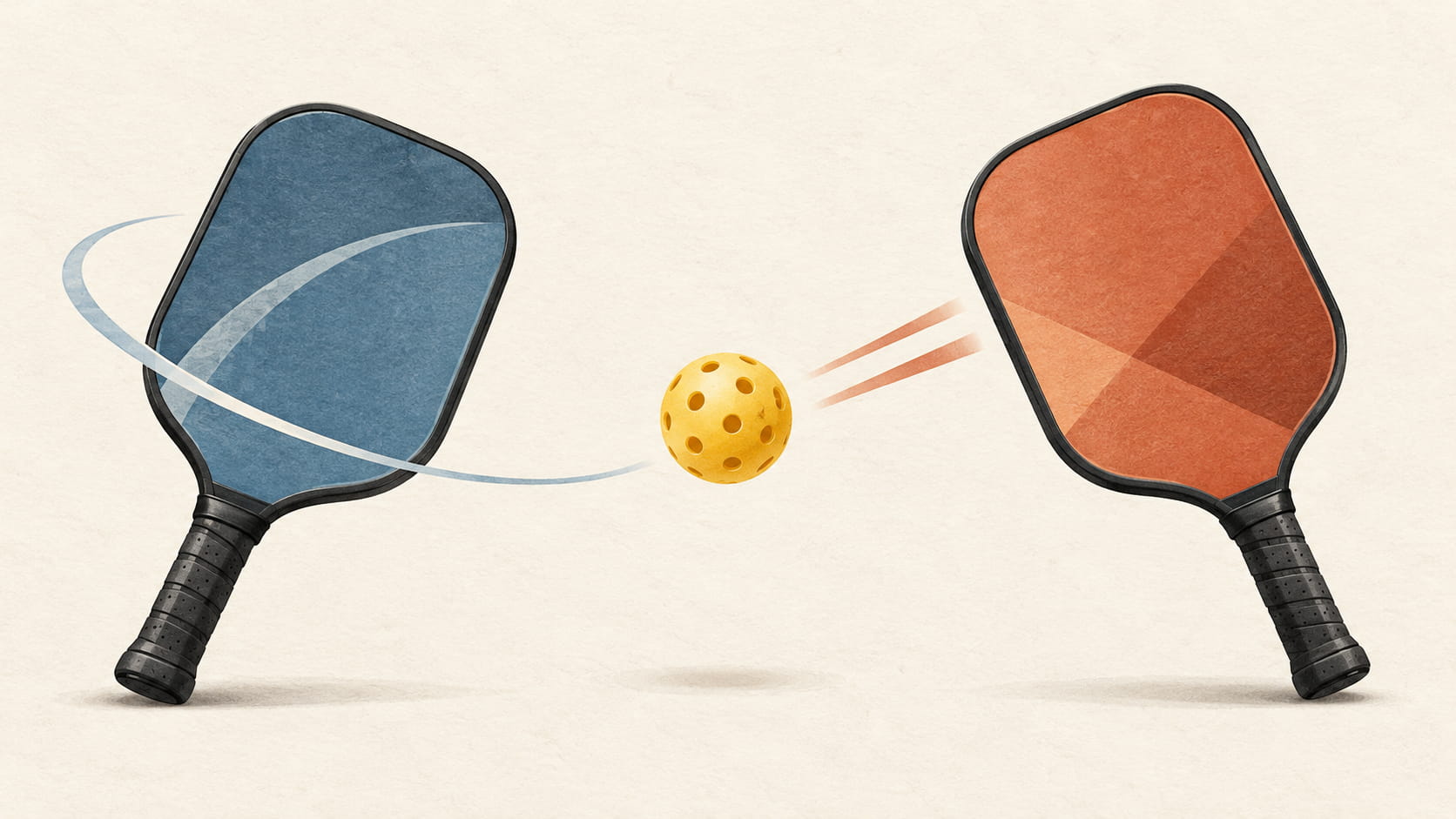
Comparing control vs power pickleball paddles is easier when you start with the shots you want to play. A control paddle emphasizes placement and touch. A power paddle emphasizes attacking pace. An all-court paddle aims to support both parts of the game.
Start with control if managing depth and soft shots is your main priority. Explore power if you want more pace on attacks while keeping your routine shots dependable. Include all-court options if you want to move comfortably between patient rallies and attacking opportunities.
Control vs power pickleball paddles at a glance
The category tells you what a paddle is designed to emphasize. Use it to build a shortlist, then compare the actual models.
| Direction | A useful starting point when… | Keep this in your comparison |
|---|---|---|
| Control | You want to prioritize placement, low soft shots and repeatable depth. | Whether serves and attacking shots still feel comfortable. |
| Power | You want more pace on drives, serves and finishing shots. | Whether you can still manage blocks, drops and dinks. |
| All-court | You mix soft placement, quick exchanges and attacks. | Which parts of your game matter most, because all-court models can lean in different directions. |
Control is about putting the ball where you intended. You notice it on a dink—a gentle shot played near the net—or a drop that lands softly in the kitchen, the non-volley zone beside the net. A reset takes pace off an opponent’s attack so you can return to a softer rally. A calm response can be appealing, but the paddle also needs to feel manageable when you react quickly.
Power concerns the pace available on attacking shots. Think of a serve, a drive from the baseline or a high volley you want to finish. The useful question is whether that pace comes with a swing you can repeat.
You will also see pop in paddle descriptions. Pop refers to the lively response you notice on short contacts, such as a compact counter or punch volley. Enjoying a paddle’s full-swing power does not necessarily mean you will enjoy its response on a short block. Our power pickleball paddle guide explains that distinction in more detail.
Which direction fits your game?
Think about a few recent games. Which shots felt comfortable, and which ones made you change your swing or hesitate? That is a more useful starting point than deciding whether you are an “aggressive” or “defensive” player.
Consider control when placement is your priority
You may already produce enough pace on a drive. The difficult part is slowing the next ball down, keeping a reset low or placing a return deep without sending it long.
In that situation, include control-oriented paddles in your shortlist. Compare how comfortably you can take pace off an incoming ball and repeat a soft shot. Then hit your normal serve and drive to see whether you still have the depth you want.
A powerful swing does not oblige you to buy a power paddle. If you create pace easily, you may prefer to spend more attention on placement. Your technique, timing and contact point still matter, so look for a paddle that feels comfortable alongside the skills you are practising.
Consider power when attacking pace is your priority
Perhaps you place the ball well but feel you have to take a large swing to create useful depth. Or you often reach a high ball in a good position and struggle to put it away comfortably.
A power-oriented paddle is worth comparing in those situations. Look at the effort needed for the shots you want to improve, then check what happens when the rally slows down. A quicker drive is more useful when you can also keep a routine drop low.
Pay particular attention to short contacts. If you enjoy the pace on a serve but keep lifting blocks, you may want a different response on compact shots. That is a reason to compare another model, including an all-court option, rather than assuming every power paddle will feel the same.
Consider all-court when you want several ways to win a point
An all-court paddle is a useful place to start if you like to dink patiently, block a hard drive and attack an opening with the same paddle. You might also include one while you are still discovering which parts of the game you enjoy most.
All-court describes a broad design direction. One model may put more emphasis on touch; another may feel livelier during an attack. Compare the shots that matter to you instead of expecting every all-court paddle to sit at an exact midpoint between control and power.
Can a power paddle still be easy to control?
Yes. More attacking pace does not automatically make a paddle difficult for every player to control. You may find a lively response predictable, while another player prefers a calmer response and a fuller swing.
It helps to ask two questions separately: Can I create the pace I want? Can I place the ball where I intended? You can like the answer to both. Pickleball Science’s discussion of power and control as separate dimensions explores this idea through its paddle-dynamics work.
Soft feel is another part of the decision. A paddle can feel pleasant at contact yet still be awkward for you to position during a fast exchange. Include both touch and handling when you compare your options.
Read beyond the thickness and material labels
A 16mm paddle can belong to different categories
Thickness helps describe a paddle’s construction. It does not tell you everything about its response. Face construction, core design, shape and the amount and distribution of mass also belong in the comparison.
For a closer look at why these factors need to be considered together, Tennis Warehouse University’s research on paddle materials and performance examines how structure and mass distribution contribute to rebound. When shopping, use the full model description and available measurements alongside the thickness number.
Listed weight and swingweight answer different questions
Listed weight tells you how much a paddle weighs on a scale. Swingweight describes its resistance to being swung around a pivot near your hand. Two paddles with the same listed weight can therefore feel different in motion.
You may also see twistweight, which describes resistance to twisting around the paddle’s long axis. It is relevant when comparing how a paddle responds to contact away from the centre. Tennis Warehouse University explains both terms in its paddle comparison tool.
For your own choice, check whether you can prepare the paddle, meet the ball and recover comfortably. A familiar weight range is a starting point; the way the paddle moves matters too. Our paddle weight guide explains weight ranges, unit conversions and how to record the setup you actually use.
How BECAVO A01 and P01 fit into the choice
BECAVO’s current lineup gives you an all-court direction and a power direction to compare. Both models have a T700 carbon fiber face and 16mm thickness, with different core materials.
| Model | Series direction | Core material |
|---|---|---|
| BECAVO A01 | A Series / All-Court | Polypropylene (PP) honeycomb |
| BECAVO P01 | P Series / Power | MPP foam |
The BECAVO A01 is the all-court starting point if your game moves between soft placement, quick exchanges and attacking opportunities. The BECAVO P01 belongs to the power collection for players who want to build points around drives and finishing shots.
This is also a useful example of why “16mm carbon fiber” leaves more to compare. The two models share those specifications while sitting in different series. Use their playing directions to make your initial choice, then check dimensions, grip fit and the rest of the specifications in the A01 vs P01 Paddle Guide.
Take one clear question to your next comparison
If you can borrow or demo a paddle, bring your current one as a reference. Choose one shot you want to improve and one shot you already trust. For example, compare a drive you would like to hit more comfortably, then return to a familiar dink or block.
Keep the ball, feeding partner and target consistent where practical. After trying both paddles, write down three things:
- Did the shot I wanted to improve feel easier to repeat?
- Could I still play my dependable shot with a familiar movement?
- What adjustment would I need to practise?
A note such as “easier depth on drives, but blocks needed a smaller movement” gives you something useful to compare. Finish with a few points so you can judge the paddle while reacting, moving and choosing a shot.
Common questions about control and power paddles
Should beginners choose control or power?
Start with a comfortable grip, manageable handling and a response that helps you repeat ordinary shots. Include control and all-court options, but keep an open mind about the actual model. If you struggle to create depth comfortably, try a power option too and check your soft shots alongside your drives.
Is every 16mm paddle a control paddle?
No. Sixteen millimetres is a thickness measurement, not a complete description of how a paddle plays. BECAVO A01 and P01 are both 16mm, while their series directions and core materials differ. Compare the full construction, size and fit, then judge the shots you need from the paddle.
Does a carbon fiber face mean better control?
A carbon fiber face is one part of a paddle’s construction. The finished response also involves its core, shape, mass distribution and the rest of the build. Compare specific models rather than assuming all carbon fiber paddles will give you the same touch, rebound or handling.
Is all-court the same as control?
All-court usually describes a design intended to support a varied game, including both soft shots and attacks. Control puts more emphasis on placement and touch. The labels can overlap in everyday use, so check how the brand describes the particular model and which shots it is intended to support.
Choose around the game you want to play
Start your control vs power pickleball paddle comparison with a clear priority. If placement and soft shots matter most, include control-oriented options. If attacking pace is the priority, explore power while keeping touch in the comparison. If you enjoy both, give all-court models a place on your shortlist.
Then compare the actual paddle with the game you already know. The most useful improvement is one you can repeat through a whole point.